Apportionment and Recovery Percentages: Irish Charities
Updated 30 October 2026
Written for the 2026 VAT codes
This article uses the 2026 VAT codes that new customers are set up on. If your codes look like S1 - IE or P1 - IE, you are on the current codes: see Moving to the 2026 VAT Codes.
This article is for Irish charities that are registered for VAT and have free activities, exempt income, or both.
What this means for a charity
A VAT-registered charity can only deduct VAT on costs used for its taxable activities. There are two limits:
- Non-business activities. VAT on costs for free or below-cost services funded by donations and grants cannot be deducted.
- Exempt activities. VAT on costs for exempt income, such as care, health, education or fundraising events, cannot be deducted.
VAT you cannot deduct may be partly refunded under the Charities VAT Compensation Scheme.
Your codes
| Code | Use it for | Example |
|---|---|---|
TAX-PUR-23 |
Costs used only for taxable activities | Stock for a charity shop selling new goods |
OOS-PUR-23 |
Costs used only for free activities | Printing a free information leaflet |
EXE-PUR-23 |
Costs used only for exempt activities | Equipment for a care service |
RES-PUR-23 |
Shared costs | Head office rent, audit fee, finance system |
RES-PUR-23-RC |
Shared services bought from outside the EU. For EU suppliers, use RES-PUR-23-EUS |
Software subscriptions from a US supplier |
There are 13.5%, 9% and 0% versions of these codes. Aedon posts RES-PUR-NA-PEA itself, so you never enter it manually.
The two percentages
Shared costs go through two steps:
- Business percentage. The share of your activity that is business, rather than free activity. Your accountant agrees a fair way to work it out, such as income or staff time.
- Recovery percentage. The share of your business activity that is taxable. The main method is taxable turnover ÷ total turnover. A different method is used where turnover does not fairly reflect how your costs are used.
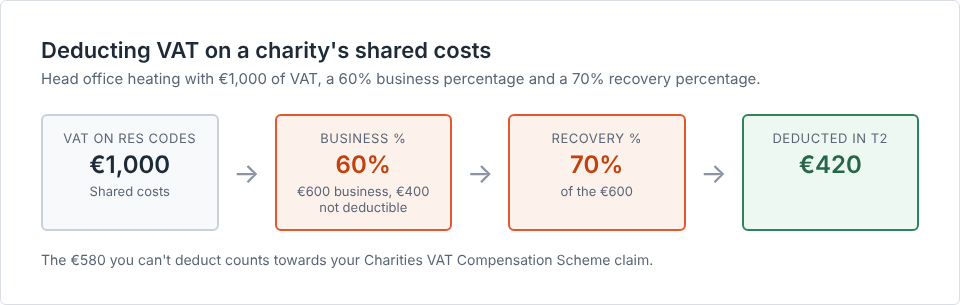
For example, head office heating carries €1,000 of VAT. With a 60% business percentage, €600 is business and €400 cannot be deducted. With a 70% recovery percentage, you deduct €420 of the €600. The €580 you cannot deduct counts towards your Compensation Scheme claim.
What Aedon does at each VAT3 return
- Adds up the VAT on your RES codes.
- Applies your business percentage, then your recovery percentage.
- Posts one journal that puts the VAT you can deduct in T2 and the rest into costs.
- Records the VAT you cannot deduct for your Compensation Scheme report.
The annual review
At the end of each accounting year, the percentages are worked out again on the year’s actual figures, and the VAT deducted is adjusted. Aedon posts the adjustment on the return your accountant tells us to use.
What we need from your accountant
| Setting | Example |
|---|---|
| Business percentage, and how it is worked out | 60%, by staff time |
| Recovery method | Turnover, or an alternative method |
| Accounting year end for the review | 31 December |
| Current recovery percentage | 70% |
| Return for the annual adjustment | The first return after the year end |
Useful official links
- Value-Added Tax Consolidation Act 2010, section 61: Apportionment for dual-use inputs
- Revenue Notes for Guidance, Finance Act 2016: amendment of section 61
- Revenue guidance: VAT Compensation Scheme for charities
- The Charities VAT Compensation Scheme: Irish Charities
Need help?
Ask your accountant about your method and percentages.
For help with Aedon.Accounting itself, please raise a case and our support team will help.
Related articles
Choosing the Right VAT Code: UK Charities
Claiming Gift Aid from HMRC
Donor Gift Aid Statements
Getting Started with Aedon.Charities
Gift Aid Declarations and Eligible Products
Partial Exemption and Recovery Percentages: UK Charities