Creating a Bank Payment
Updated 31 October 2026
A Bank Payment records money going out of a bank account that isn’t a payment of a supplier invoice, for example bank charges, wages, a direct debit to HMRC or a refund of a deposit. Supplier invoices are paid with a Purchase Payment instead.
Every Bank Payment is recorded against an Account, which can be a customer, a supplier or another organisation such as your bank or HMRC.
Recurring payment?
If the same payment appears on your bank statement regularly, set up a bank matching rule instead. The rule creates and posts the Bank Payment for you when you reconcile. See Bank Matching Rules.
Create a Bank Payment
- Open Aedon.Bank, click the Bank Payments tab and click New.
- Enter the Date, and choose the Account, Company and Bank Account(1). Add a Customer Reference if you want one.
- Click Save(2).
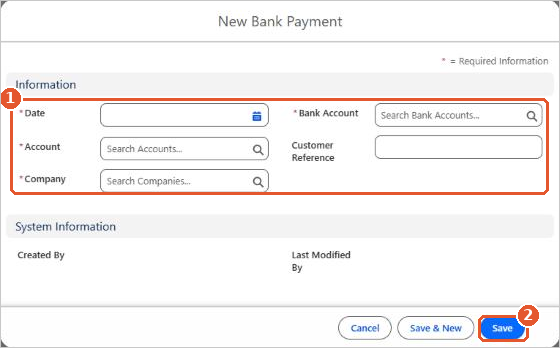
The Bank Payment opens as a Draft. Now add what the payment was for.
- In Bank Payment Line Item(s)(1), click +(2) to add a line.
- Choose a Product if you use one. It fills in the nominal code and VAT for you. Otherwise, leave it blank.
- Enter the Quantity (usually 1) and the Unit Price, and choose the Nominal Code and VAT code.
- Scroll the line to the right to add any analysis codes, such as Fund or Project.
- Click the save icon above the lines to save them.
- Check the Gross Amount and Net Amount at the top, then click Post(3).
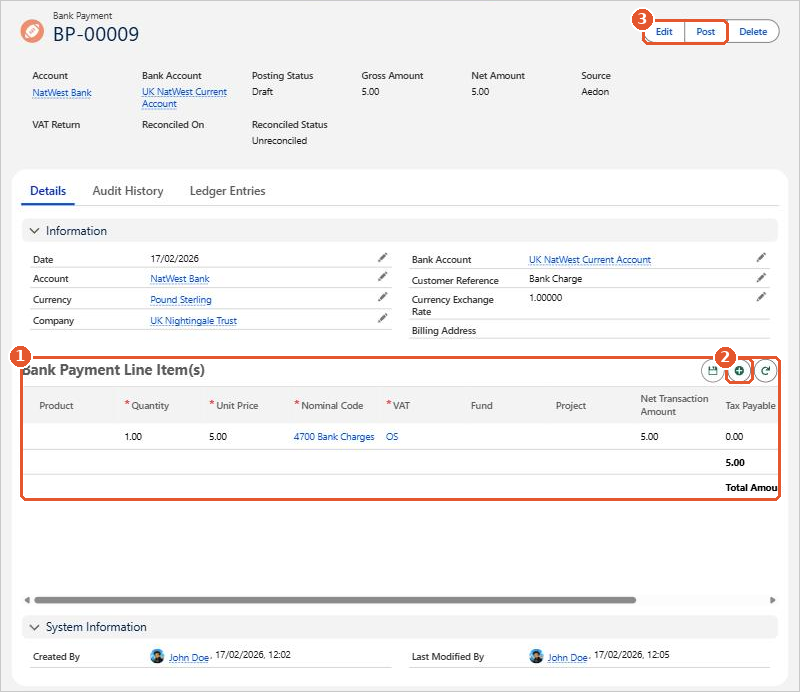
Once it’s posted, the Posting Status changes to Posted and the ledger entries are created. You can see them on the Ledger Entries tab, and any changes are recorded on the Audit History tab.
When the payment appears on your bank statement, reconcile it on the bank account’s Reconcile tab. It is picked up by Refresh Match, or you can use Match to Payment.
Can’t post it? Check that every line has a Nominal Code and VAT code, and that the date falls in an open financial period. If it still won’t post, please raise a case and our support team will help.