Partial Exemption and Recovery Percentages: UK Businesses
Updated 30 October 2026
Written for the 2026 VAT codes
This article uses the 2026 VAT codes that new customers are set up on. If your codes look like S1, P1 or TP20, you are on the current codes: see UK VAT Codes (Tax Codes) and Moving to the 2026 VAT Codes.
This article is for UK businesses with both taxable and exempt income, such as a property company that charges VAT on some rents but not others.
What partial exemption is
If you make both taxable and exempt sales, you can only reclaim the VAT on costs used for your taxable sales. VAT on costs used only for exempt sales cannot be reclaimed. VAT on shared overheads is reclaimed in part, using a recovery percentage.
Your codes
| Code | Use it for | Example |
|---|---|---|
TAX-PUR-20 |
Costs used only for taxable sales | Repairs to a commercial building you have opted to tax |
EXE-PUR-20 |
Costs used only for exempt sales | Repairs to a residential flat you let |
RES-PUR-20 |
Overheads shared by both | Head office rent, audit fee, IT |
RES-PUR-20-RC |
Overhead services bought from overseas | Software subscriptions from a non-UK supplier |
There are 5% and 0% versions of the EXE and RES codes. Aedon posts RES-PUR-NA-PEA itself, so you never enter it manually.
How the recovery percentage works
Most businesses use the standard method:
Recovery percentage = taxable sales ÷ total sales, excluding VAT.
- The percentage is rounded up to the next whole number. It is rounded to 2 decimal places if your residual VAT averages more than £400,000 a month.
- Sales of capital assets, incidental bank interest and the value of reverse charge services are left out.
- A different method, called a special method, needs HMRC’s written approval.
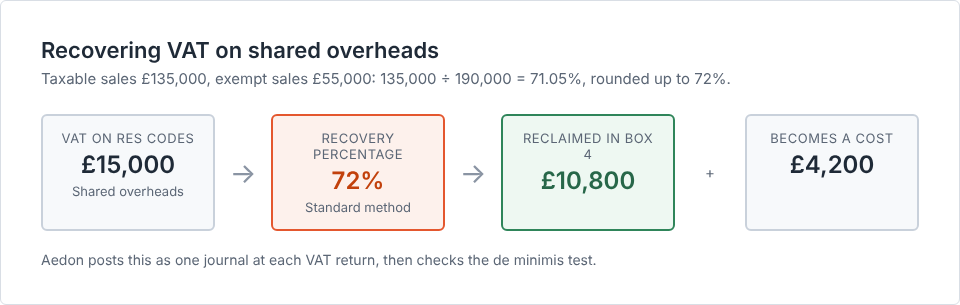
For example, with taxable sales of £135,000 and exempt sales of £55,000, the percentage is 71.05%, rounded up to 72%. On £15,000 of residual VAT, you reclaim £10,800.
What Aedon does at each VAT return
- Adds up the VAT on your RES codes.
- Applies your recovery percentage.
- Posts one journal that puts the VAT you can reclaim in Box 4 and the rest into costs.
- Checks the de minimis test.
The de minimis test
You can reclaim all your VAT, including the exempt part, if your exempt VAT is both:
- no more than £625 a month on average, and
- no more than half of all your input VAT.
Aedon checks this each period and again at the year end.
The annual adjustment
At the end of your partial exemption year, the recovery percentage is worked out again on the whole year’s figures. The difference is posted on the last return of the year, or the first return after it. Your partial exemption year normally ends on 31 March, 30 April or 31 May.
What we need from your accountant
| Setting | Example |
|---|---|
| Method | Standard or special |
| Partial exemption year end | 31 March |
| Current recovery percentage | 72% |
| Return for the annual adjustment | First return after the year end |
Useful HMRC links
- HMRC VAT Notice 706: Partial exemption
- HMRC guidance: Apply for a partial exemption special method
- HMRC VAT Notice 700/12: How to fill in and submit your VAT Return
Need help?
Ask your accountant about your method and percentages.
For help with Aedon.Accounting itself, please raise a case and our support team will help.
Related articles
Apportionment and Recovery Percentages: Irish Businesses
Apportionment and Recovery Percentages: Irish Charities
Choosing the Right VAT Code: Irish Businesses
Choosing the Right VAT Code: UK Businesses
Choosing the Right VAT Code: UK Charities
Creating New Tax Codes